- Home
- Products
- About Us
- News
- Contact Us
Leave Your Message
Picking an Rv Mppt Solar Controller in 2026 isn’t just about comparing charging rates on a product page. If you’ve spent real time on the road, you know it has to fit your battery bank, solar array, and the way you actually travel. Start with max PV voltage. A cold rooftop panel can put out more voltage than the label says—yep, even more than you’d expect. Then look at charging current, battery chemistry support, temperature compensation, idle draw, and protection features.
Will Prowse, a well-known solar educator and hands-on tester, often says, “Measure your system before you buy the equipment.” That advice really matters in a moving RV. A 400-watt array, lithium batteries, and long roof cables can reveal weak spots that never show up in a showroom. Victron Energy, Renogy, and Go Power! all have different monitoring systems, but brand familiarity shouldn’t replace technical matching. Bluetooth is handy. Still, it’s no substitute for correct wiring.
Pay attention to installation details, too. Use the right cable sizes, tighten every terminal, and give the controller some ventilation. A 40-amp controller may not do so well when heat builds up inside a crowded cabinet. And real-world efficiency can differ from lab claims. Easy to overlook, honestly.
The best Rv Mppt Solar Controller isn’t always the priciest one. It’s the one that safely manages your array, battery, and daily driving routine. One thing I should admit: weather, shading, and battery age can change results a lot. Even a careful choice needs testing after installation. A few small measurements can save you from expensive surprises.
Defining your RV solar requirements starts with daily energy use, not controller size. List every load: refrigerator, water pump, lights, fans, devices, and inverter losses. Multiply each appliance’s watts by expected operating hours. For example, a 45-watt refrigerator running eight equivalent hours uses about 360 watt-hours daily. Add a practical reserve of 20% to 30%. Real usage changes with weather, driving, and personal habits. The U.S. Department of Energy recommends evaluating appliance energy consumption before designing an off-grid system. Guessing is convenient, but often expensive.
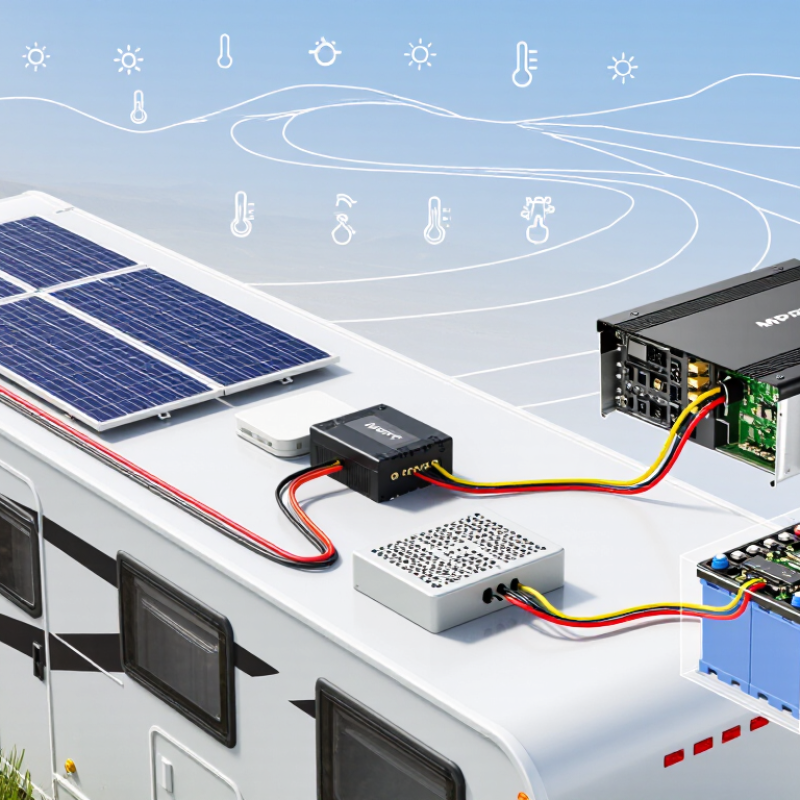
Next, match the solar array, battery bank, and controller. A 600-watt array charging a 12-volt battery may produce about 42 amps at 14.4 volts. A controller rated near 50 amps provides reasonable headroom. Check the array’s maximum open-circuit voltage during cold mornings. It must remain below the controller’s input limit. NREL’s PVWatts documentation uses a default 14% system-loss assumption, which is a useful planning reference, not a guarantee. Roof shading can make losses higher. That detail is easy to overlook.
Battery capacity also needs honest calculation. A 12.8-volt, 200-amp-hour battery stores roughly 2,560 watt-hours nominally. Usable energy depends on battery chemistry, temperature, discharge limits, and inverter efficiency. I would not design around perfect sunshine. Compare your estimated daily demand with winter solar production from NREL’s National Solar Radiation Database. Then select an MPPT controller that supports the battery’s charging profile, array voltage, and expected current. Oversizing the panel array slightly can help, but excessive oversizing may waste money or exceed controller limits.
| RV Solar Profile | Typical Daily Loads | Estimated Daily Energy | Battery Bank | Recommended PV Array | Approx. Peak Charge Current | Suggested MPPT Controller Rating | Design Check |
|---|---|---|---|---|---|---|---|
| Basic Weekend RV | LED lighting, water pump, device charging, small control systems | 0.8 kWh/day | 12 V, 100 Ah LiFePO4 About 1.08 kWh usable at 90% depth of discharge |
400 W | About 28 A 400 W ÷ 14.4 V |
40 A MPPT minimum | Suitable for a compact 12 V system with moderate daytime charging demand. |
| Balanced Full-Use RV | Lighting, refrigeration controls, water pump, electronics, fans, and occasional inverter use | 1.5 kWh/day | 12 V, 200 Ah LiFePO4 About 2.16 kWh usable at 90% depth of discharge |
600 W | About 42 A 600 W ÷ 14.4 V |
60 A MPPT minimum | Provides useful charging headroom for cloudy periods and moderate future expansion. |
| High-Consumption RV | Residential-style refrigerator, fans, electronics, kitchen appliances, and regular inverter loads | 2.2 kWh/day | 12 V, 300 Ah LiFePO4 About 3.24 kWh usable at 90% depth of discharge |
800 W | About 56 A 800 W ÷ 14.4 V |
80 A MPPT minimum | Check battery charge acceptance, cable size, fuse rating, and controller cooling at full output. |
| Extended Off-Grid RV | Large refrigeration loads, communication equipment, fans, cooking support, and frequent inverter use | 3.5 kWh/day | 12 V, 400 Ah LiFePO4 About 4.32 kWh usable at 90% depth of discharge |
1,200 W | About 83 A 1,200 W ÷ 14.4 V |
100 A MPPT minimum or two 60 A units |
Splitting the array across two controllers can simplify wiring and improve thermal management. |
| Selection assumptions and checks: Values assume a 12 V nominal battery system, approximately 4 peak-sun-hours per day, about 85% overall solar-system efficiency, and a lithium battery usable depth of discharge near 90%. Actual output varies with season, shading, roof orientation, panel temperature, and battery state of charge. Size the controller from the maximum PV charging current, then select the next standard current rating above that value. Confirm that the controller’s maximum PV open-circuit voltage remains above the array’s cold-weather corrected Voc, and install appropriately rated fuses, disconnects, conductors, and battery protection. | |||||||
Global wind power is entering a higher-growth phase. According to the Global Wind Energy Council’s *Global Wind Report 2024*, the industry added a record 117 GW of new capacity in 2023, representing roughly 50% year-on-year growth and bringing cumulative global capacity above 1,000 GW. This expansion also highlights a practical challenge: as wind resources fluctuate and distributed systems become more common, controllers must capture energy efficiently while maintaining stable operation. A 3 kW MPPT wind controller addresses this need through adaptive power-capture logic that continuously tracks available turbine power under changing wind conditions, reducing energy loss and improving overall generation yield.
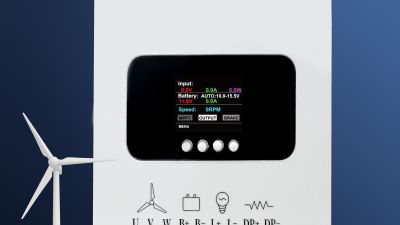
Designed for demanding outdoor applications, the controller combines a dedicated high-speed processor with a low-loss boost architecture to reduce conversion heat and power attenuation. Real-time monitoring covers turbine speed, battery voltage and current, wind input, DC output, and automatic braking status, allowing operators to assess system performance quickly. Intelligent battery detection supports standard 12 V, 24 V, and 48 V systems, while adjustable voltage settings accommodate custom battery configurations. When wind speed rises sharply or the battery reaches full charge, the integrated braking resistor activates load-dump protection to limit overspeed and overvoltage risks. A 2-inch full-color IPS display provides clear on-site access to operating data and parameter adjustments.
List every load, including the refrigerator, pump, lights, fans, devices, and inverter losses. Multiply each appliance’s wattage by its expected operating hours. A 45-watt refrigerator running eight hours uses about 360 watt-hours. Add a 20% to 30% reserve. Guessing costs.
Cloudy weather, roof shade, driving schedules, and personal habits reduce real production. Compare daily demand with winter solar availability. A bright summer estimate may fail during a gray afternoon. That matters.
They must match in output, storage capacity, voltage, and charging current. For example, a 600-watt array may produce about 42 amps at 14.4 volts. A controller near 50 amps offers useful headroom. Do not rely on exact calculations alone.
Its nominal storage is roughly 2,560 watt-hours. Usable energy depends on chemistry, temperature, discharge limits, and inverter efficiency. The full number is not always available. I sometimes overestimated it.
Check the array’s maximum open-circuit voltage during cold mornings. It must stay below the controller’s input limit. Cold conditions can increase panel voltage. This small check prevents a costly mismatch.
Lead-acid batteries usually need bulk, absorption, and float stages. Lithium iron phosphate batteries often need shorter absorption and little or no float charging. Their settings are not interchangeable. Follow the battery documentation.
Temperature compensation commonly suits lead-acid batteries. It may be unsafe for lithium batteries unless the battery management system allows it. Check low-temperature charging protection and permitted voltage settings. Heat makes mistakes worse.
Confirm battery chemistry support, charging stages, maximum current, array voltage, and temperature features. Check whether remote temperature sensing is appropriate. A high efficiency claim cannot fix incorrect settings. Specifications need careful reading.
Choosing an Rv Mppt Solar Controller in 2026 starts with a clear understanding of your RV’s energy needs. Estimate daily consumption, solar panel output, battery capacity, and expected charging conditions before selecting a controller. MPPT technology can improve energy harvest by continuously adjusting the operating point of the solar array, especially when sunlight or panel voltage changes. Confirm that the controller’s maximum input voltage and charging current safely match your solar array, while leaving reasonable room for normal operating variations.
Battery chemistry is equally important because lithium, AGM, gel, and flooded batteries require different charging profiles and voltage limits. Look for essential protections such as overcharge, overcurrent, overheating, reverse polarity, and short-circuit safeguards, along with clear monitoring options and practical installation access. Finally, evaluate efficiency, physical size, wiring compatibility, ventilation needs, and future expansion capacity. A properly sized controller should support your current setup reliably while allowing sensible upgrades without exceeding its electrical or thermal limits.